What Software as a Service (SaaS) Means for Manufacturers
Software as a service (SaaS) is software you rent and use through a browser instead of installing on your own server. The simplest software as a service SaaS definition, taken straight from NIST SP 800-145: the vendor runs the application on cloud infrastructure, and you don't manage the network, the servers, the OS, or the storage. You log in, you pay a subscription, and the vendor handles the rest.
Most "what is SaaS" articles are written for marketing teams choosing a CRM. The answer for a 60-person job shop is different. Your software might run a CNC panel, a label printer, and the audit trail an FAA inspector pulls during an AS9100 inspection. The questions a manufacturer has to ask before signing a SaaS contract are not the questions a marketing team asks.
Why manufacturers ask this question differently
Most SaaS explainers assume you're a 50-person agency with a Google Workspace account and an internet connection that doesn't drop when it rains. That isn't a job shop.
Manufacturers carry constraints that don't show up in a McKinsey deck:
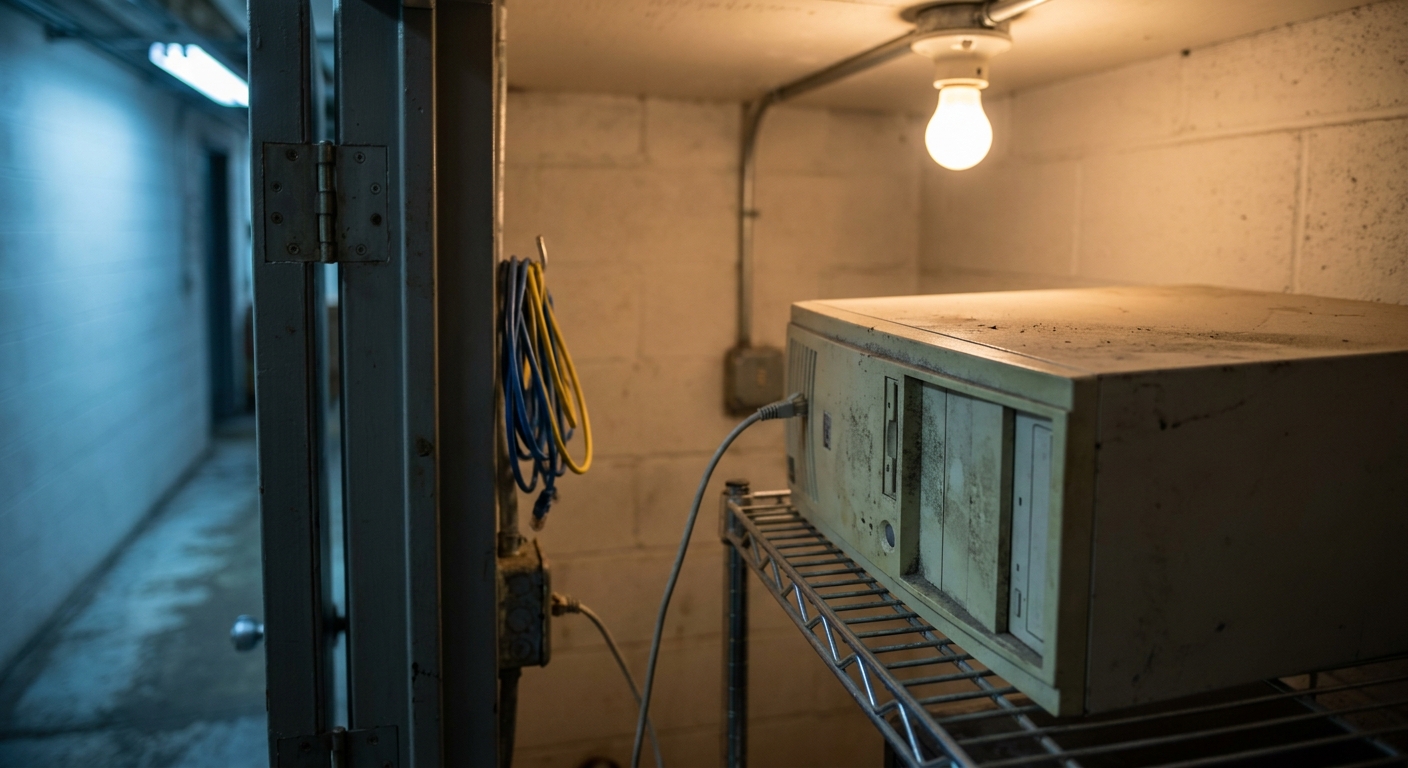
- The on-prem server in the closet runs production-floor terminals, the time clock, the label printer, and the file shares for engineering drawings. Pull the wrong wire and three departments stop.
- Audit trails for AS9100, ISO 9001, ITAR, and FDA 21 CFR Part 11. The chain of custody on a part record is non-negotiable.
- OT/IT segmentation. Your CNCs talk to a controller IT isn't allowed to touch. The Purdue Model puts PLCs at Levels 0-2 and ERP at Levels 4-5, with a Level 3.5 DMZ in between. Cloud integrations are expected to traverse the DMZ, not connect directly to a PLC.
- Latency budgets. VarTech's reference numbers: safety-critical control loops need under 1 millisecond, edge adjustments under 100 milliseconds, operator dashboards 1 to 2 seconds. An operator scanning a router and waiting 4 seconds for a screen to load will go back to paper inside a week.
- The maintenance window is "Sundays at 6 AM, and you better be done by 7." There's no second-shift IT person to babysit a cutover.
These constraints don't disqualify SaaS. They mean the right answer to "is SaaS a fit?" varies by module, by shop, and by use case.
The NIST definition, in shop-floor terms
NIST SP 800-145 is the canonical software as a service definition. Translated for a manufacturer:
- The vendor runs it. Their AWS account, their data center, their problem at 2 AM.
- You don't manage the OS, the database, or the patches. No Windows Server licenses to renew. No quarterly DBA bill.
- You access it through a browser. Office staff log in from any laptop. Operators log in from a panel PC on the floor.
- You pay a subscription. Monthly or annual, per user or per site, in place of a perpetual license plus 22% annual maintenance.
- It's multi-tenant. Other manufacturers run on the same logical instance, with their data isolated. That's how the vendor amortizes infrastructure costs across customers and how you get updates without paying for them.
That last point matters. A vendor's traditional product, hosted on AWS but installed and managed for one customer, isn't really SaaS. It's hosted on-prem with a different bill payer. True SaaS is the multi-tenant subscription model. That's what makes the cost and update advantages possible.
Four signals that SaaS is the right call for a given module
SaaS is the right answer for some software a manufacturer buys, and the wrong answer for other software the same manufacturer buys. The signals:
1. The module is for office staff, not operators
CRM, accounting, quoting, expense tracking. None of these touch a PLC. SaaS software for manufacturers is almost always the cleaner answer for the office side. The Panorama 2024 ERP Report shows 78.6% of new ERP deployments now choose cloud/SaaS, up from 64.5% in 2023, and the office-side modules are where most of that 14-point YoY swing is concentrated.
2. Your current install is more than 8 years old
Ultra Consultants pegs the typical "legacy" line at 8 to 10 years. Past that, security patches dry up, the consultant who installed it doesn't return calls, and the annual maintenance line gets expensive faster than the software gets better. The on-prem renewal is the natural decision point. Most shops don't replace one module at a time proactively; they do it when the renewal comes up and the vendor wants 18% more for the same product.
3. You don't have full-time IT
Most SMB manufacturers don't. They have someone who "does IT stuff" along with their actual job. SaaS shifts the server, patching, backup, and disaster-recovery burden to the vendor. For a 50-person shop without a dedicated sysadmin, that trade is almost always worth it. For a 5,000-person plant with a tenured IT staff and a sunk-cost SAP install, the math is different.
4. Compliance is verified, not assumed
ITAR-covered work used to be an automatic SaaS disqualifier. It isn't anymore. AWS GovCloud (US) is operated solely by U.S. citizens on U.S. soil and supports ITAR, EAR, FedRAMP High, CMMC, and DoD SRG IL2/4/5. Plenty of SaaS manufacturing platforms run on it. The catch: you have to verify the vendor's hosting environment is what they claim. "We're SOC 2 certified" is not the same as "we're ITAR-compliant on GovCloud." Ask for the documentation.
Where SaaS still doesn't belong
Shop-floor execution (work orders, time tracking, machine integration, OEE) is the honest "with caveats" answer for most shops.
The reason is architectural, not philosophical. PLCs and SCADA systems live at Purdue Levels 0-2 and need real-time control loops. A pure-cloud SaaS system that requires a round trip to AWS for every operator scan adds latency that breaks the workflow. The fix is edge architecture: a well-designed SaaS platform runs edge components on local hardware while keeping the system of record in the cloud. Operator scans hit a local agent in under 100ms; the cloud sync happens asynchronously.
If your vendor can't draw that picture in one sitting, their product wasn't built for the floor. The shop floor module is where your shop actually makes money. The architecture deserves the slow questions.
What SaaS actually buys you
The pitch usually starts with "no servers." That's table stakes. The real wins for a manufacturer:
- Updates that arrive automatically. Your on-prem ERP from 2014 isn't getting AI features. Your SaaS one will, in the next quarterly release.
- Uptime SLAs you can point to. AWS provides a 10% service credit when monthly uptime falls below 99.95% and 30% below 99%. Most reputable SaaS vendors carry contractual uptime between 99.5% and 99.9%, with 99.95% to 99.99% as the e-commerce best-practice band per TechTarget. Your closet doesn't offer either.
- A clear answer when an auditor asks who has access to the production database. You don't. The vendor does, and they have a SOC 2 report.
- Disaster recovery already built. You stop being one ransomware event from a dead shop.
- TCO that's actually predictable. On-prem typically carries 22% annual maintenance on top of the license, per Arena Solutions's TCO breakdown. SaaS bundles maintenance, patches, and infrastructure into one recurring fee.
Plex Smart Manufacturing Platform (Rockwell), Epicor Kinetic (on Azure), and Oracle NetSuite with the Rootstock SuiteApp all run cloud manufacturing workloads at scale. Manufacturing is now the largest cloud-ERP vertical, accounting for 53.71% of the 2026 cloud-ERP market according to Fortune Business Insights. The "manufacturers don't trust SaaS" line is six years out of date.
For deeper context on the deployment-model decision, see cloud vs on-premise ERP for manufacturers. For the underlying question of what manufacturing software should actually do, see what is manufacturing ERP.
A real example
A 60-person sheet-metal shop in Macomb County renewed its CRM contract in October 2024. The on-prem CRM was 9 years old, with a Microsoft Access front end and a $14,000 annual maintenance contract. They priced a SaaS replacement, ran it in parallel for 11 weeks, and switched the day after Christmas. The old system stayed read-only through February. Total extra cost: about $4,200 in dual subscriptions.
Eighteen months later they've made the same call for accounting, purchasing, and quoting. Each switch happened at a vendor-renewal trigger, not as part of a wholesale project. Shop-floor execution is still on-prem. They're piloting a single cell on a SaaS MES starting next quarter. The IT contractor they used to pay $90,000 a year is now retained for $1,800 a month. There was no big migration project. There was a series of renewal-driven decisions.
FAQs
What is a SaaS, and how is it different from cloud software?
What is a SaaS in one sentence: a specific cloud delivery model where the vendor runs the application multi-tenant and customers access it through a browser. Cloud software is broader. Any software that runs on remote servers is "cloud." All SaaS is cloud, but not all cloud is SaaS. A vendor's on-prem app lifted onto AWS for one customer isn't SaaS, because somebody still manages it. NIST SP 800-145 draws the line at: in SaaS, the consumer doesn't control the network, servers, OS, or storage.
What is software as a service in plain English for a manufacturer?
What is software as a service from the perspective of a 60-person job shop: it's renting a manufacturing app instead of buying one. The vendor handles the server, the database, the updates, and the security patches. You handle your data, your users, and your processes. You pay monthly or annually instead of writing a $200,000 check every five years for a perpetual license plus the upgrades you'll need anyway. SMB cloud ERP typically deploys in 3 to 6 months per LeverX, versus 12 to 24 months for traditional on-prem.
What is SaaS software as a service when shop-floor latency matters?
What is SaaS software as a service in a real-time environment: a well-designed platform handles latency by running edge components on local hardware while keeping the system of record in the cloud. Operator scans hit a local agent in under 100ms; cloud sync happens asynchronously. The Purdue Model is your reference: PLCs and SCADA stay at Levels 0-2 on the floor, and the SaaS layer lives at Levels 4-5 with a Level 3.5 DMZ in between. If your vendor can't draw that picture, walk.
Where to start
The right way to evaluate SaaS for a manufacturer isn't "do we move everything to the cloud?" It's "which module's renewal is up next, and is SaaS the right call for that one?" Module by module. Renewal by renewal. The shops that get this right end up mostly on SaaS in five years without ever running a "cloud migration project."
Want to see what a manufacturing-native SaaS platform looks like before your next renewal? Book a demo and we'll walk through how WorkCell's accounting, CRM, and shop-floor modules each handle the office-side and floor-side architecture differently.