Manufacturing Traceability: Lot Tracking Guide
Introduction
A customer calls. One of your parts failed in the field. They need to know: which other units came from the same batch of raw material?
You open the spreadsheet. The lot number column is half-filled. Some entries say "see binder." The binder is in someone's office. That person is on vacation.
This is what manufacturing traceability prevents. The ability to trace a part backward to its raw materials and forward to every unit that shares those materials is what separates a controlled response from a panicked scramble. The average product recall costs $10 million in direct expenses. Companies with weak traceability pay up to 70% more per recall because they can't isolate the problem and end up pulling everything.
Most guides on this topic target large companies with dedicated quality departments. This one is for small and mid-size manufacturers who need practical traceability without an enterprise budget.
What is manufacturing traceability?
Manufacturing traceability is the ability to track materials, parts, and products through every stage of production. From raw material arriving at your dock to the finished part shipping to your customer, traceability answers two questions:
Forward traceability: Where did this material end up? If a steel supplier notifies you of a defective heat lot, you can identify every part made from that steel and every customer who received one.
Backward traceability: Where did this product come from? If a finished part fails, you can trace it back to the specific material lot, the machine it ran on, the operator who ran it, and the inspection results it passed through.
Forward tracing handles supplier problems. Backward tracing handles customer complaints. A complete traceability system does both.
Internal vs. supply chain traceability
Internal traceability tracks materials within your four walls: what came in, what happened during production, what went out. This is what most small manufacturers need to get right first.
Supply chain traceability extends beyond your facility, connecting your records with suppliers upstream and customers downstream. Aerospace and medical device manufacturers typically need this level of visibility. For most small shops, internal traceability is the starting point.
Only about 23% of factories have full traceability systems in place. If you're somewhere between paper records and complete digital tracking, you're normal. But the direction to move in is clear.
Why traceability matters (beyond compliance)
Quality control and root cause analysis
When a defect appears, traceability tells you where it started. Was it the material? The machine setup? A process deviation on second shift?
You find the lot number on the rejected part, pull every other part from that lot, and check whether the issue is isolated or systemic. If it's the material, you contact the supplier with documentation. If it's the process, you know which jobs to reinspect.
This is faster and cheaper than scrapping an entire production run because you can't narrow down the source.
Recall cost reduction
If you can identify exactly which lots are affected, you pull only those lots. If you can't, you pull everything. Recall costs for companies with poor traceability run 70% higher per incident. That number alone justifies the investment for manufacturers in regulated industries.
Customer requirements
Even outside regulated industries, OEMs and prime contractors increasingly require lot traceability from their supply chain. If a customer's quality questionnaire asks whether you can trace materials to source, "we use a spreadsheet" is not the answer they want.
Operational visibility
Traceability data feeds other systems. When you track material lots through production, you also get data about material usage per job, scrap rates by supplier, and cycle times by operation. This connects directly to real-time inventory tracking and accurate job costing.
How lot tracking works
Lot tracking is the most common method for implementing manufacturing traceability. A lot is a batch of material or product that shares a common characteristic, usually that it was received, produced, or processed together.
What a lot number is
A lot number is a unique identifier assigned to a batch of material or product. It ties that batch to its documentation: certificates of conformance, inspection results, process records, and shipping information.
A common approach for incoming materials:
YYYYMMDD-SUPPLIER-SEQ
For example: 20260315-ACME-001 tells you the material arrived on March 15, 2026, from Acme, and it was the first receipt that day. Keep it simple enough that a receiving clerk can assign the number consistently.
Tracking lots through production
Lot tracking starts at receiving and follows material through every step.
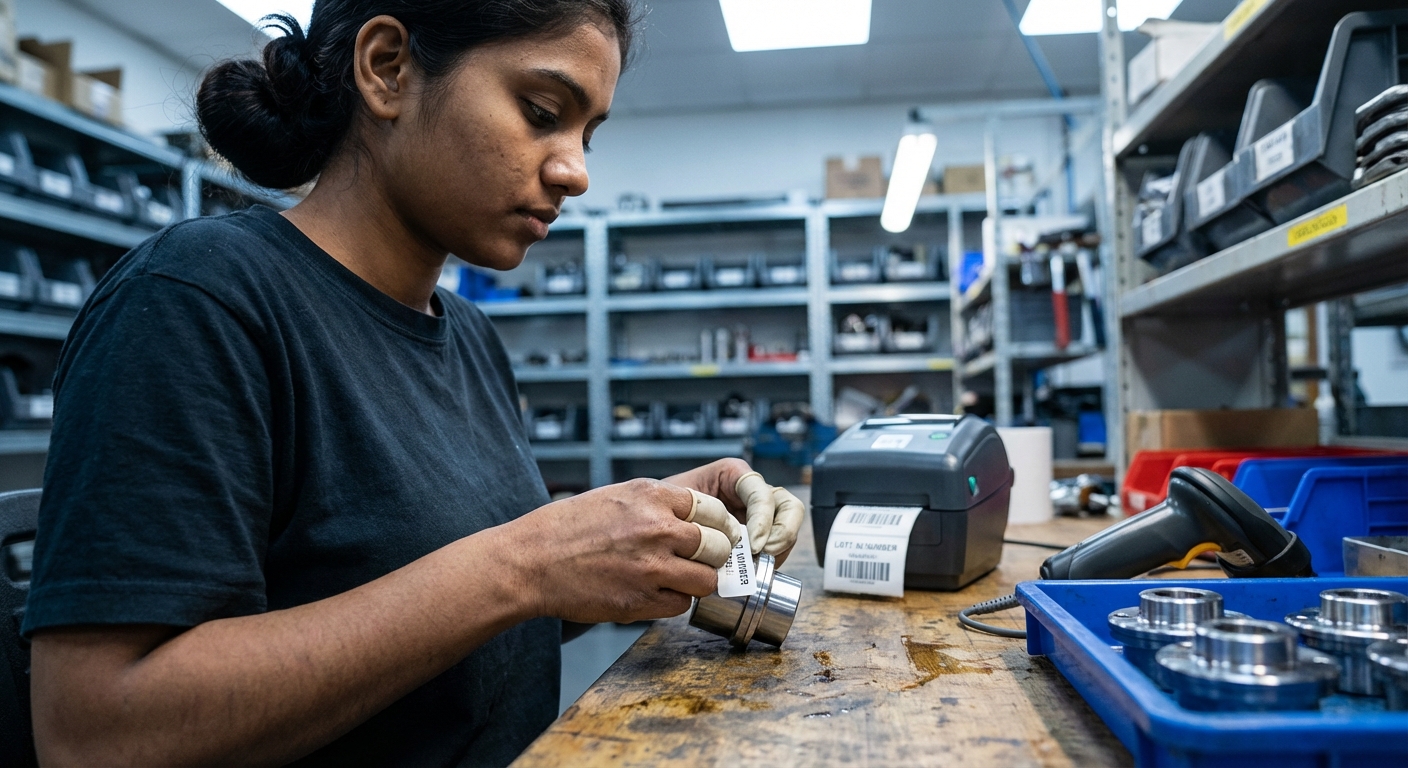
At receiving, raw material arrives with a supplier lot number and certificate of conformance. You assign your internal lot number, link it to the supplier's documentation, and tag the material.
During production, when material is pulled for a job, the work order records which lot was used. If the job uses material from multiple lots, all of them are recorded.
At inspection, quality checks reference the lot number. If a first-article fails, you know which lot of material was involved and which machine produced the part. This data feeds your first-pass yield metrics.
At shipping, completed parts carry a lot or serial number that traces back through production to the original material lot.
A practical example
A machine shop receives 12-foot bars of 4140 steel. The receiving clerk assigns lot number 20260315-STEEL-001 and logs the supplier's heat number and cert. The bars go to the rack tagged with that lot.
Tuesday, an operator pulls two bars for Job 4520. The work order notes the lot. The operator runs the parts, inspection records reference the same lot, and finished parts get lot number J4520-A.
Three weeks later, the steel supplier calls: that heat lot had an out-of-spec hardness reading. The shop searches by the supplier's heat number, finds every job that used it, and contacts the affected customers with specific part numbers and quantities. No guessing. No shutting down production to check everything on the shelf.
What compliance actually requires
Different standards require different levels of traceability. Not every shop needs full serialization.
ISO 9001
Section 8.5.2 requires traceability "where appropriate." In practice, your customers and industry define what's appropriate. Most registrars expect lot-level traceability at minimum. If you can show the link from raw material to finished product, you'll pass the audit.
AS9100 (aerospace)
Traceability requirements are strict. You need to maintain identification of parts throughout production, track material certifications, and often provide serialized part tracking. If you're in the aerospace supply chain, AS9100 quality management makes lot tracking table stakes and serialization common.
ISO 13485 (medical devices)
Every material, process step, and inspection result ties to the specific device or batch. If a device is implanted in a patient, regulators need to trace it back to the raw material supplier. This is the most documentation-heavy traceability requirement most small manufacturers encounter.
ITAR and DFARS (defense)
Defense manufacturing adds country-of-origin tracking, material certifications per DFARS 252.225-7014, and strict access controls on technical data under ITAR requirements.
When you don't have regulatory requirements
Many small manufacturers don't fall under any of these standards, but their customers might. A machine shop making components for an aerospace prime needs to meet the prime's traceability requirements, even without AS9100 certification.
Even without external requirements, basic lot traceability protects you. If a customer claims your part caused a failure, records showing material source, process parameters, and inspection results are your defense.
The spreadsheet problem
Most small shops start traceability with spreadsheets. For a while, it works. Then it doesn't.
No audit trail. Anyone can edit any cell at any time. When an auditor asks who made a change and when, you can't answer.
No real-time updates. The spreadsheet reflects what someone typed in, often hours or days behind reality. This is the same problem that drives manufacturers from spreadsheets to real software.
Single points of failure. Often one person "owns" the spreadsheet. When they're out, the system breaks.
Fragmented records. The lot tracking spreadsheet, inspection reports, supplier certs, and work orders all live in different places. Connecting a finished part back to its raw material means searching four systems and hoping the lot numbers match.
Paper and spreadsheets work for a one-person shop making a few parts a day. Once you have multiple operators, multiple shifts, or customers asking for traceability reports, the manual approach costs more in time and risk than software would cost to implement.
Building a traceability system that works
You don't need to implement everything at once.
Start at receiving
Every traceability chain starts where material enters your facility. When material arrives: assign a lot number, record the supplier and supplier lot number, log the quantity and date, and file the certificate of conformance. Link your internal lot number to the supplier's documentation so you can trace in both directions.
Get receiving right and everything downstream has a foundation.
Capture at each production step
Don't plan to backfill records later. When an operator pulls material for a job, record which lot they pulled from. The simplest version: operators write the lot number on the work order traveler. A better version: they scan a barcode and the system links the lot to the job automatically.
Connect traceability to your BOM
Your bill of materials defines what goes into each product. Traceability records what actually went into each specific unit or lot. Connecting these means you know both what should have been used and what was used. If your BOM says Job 4520 needs 4140 steel and your traceability records show 4130 was used, that's a nonconformance you can catch before shipping.
Know when to go digital
Paper-based traceability stops working when you have more than 10-15 people on the floor, customers ask for traceability reports on demand, you're preparing for ISO certification, or an auditor asks to see your records and you spend an hour pulling binders.
At that point, a manufacturing ERP or MES system with built-in lot tracking removes the manual data entry and keeps records connected.
Avoid common mistakes
Trying to track everything at once overwhelms operators and creates resistance. Start with your highest-risk or highest-volume materials.
Over-engineering the lot numbering scheme causes errors. A lot number needs to be unique and assignable without confusion. Let the system store the details.
Not training operators leaves you with incomplete records. Explain the purpose, not just the procedure.
How to get started
Step 1: Define what you need to trace. Look at customer requirements, applicable standards, and your quality history. What materials have caused problems? Start there.
Step 2: Create a lot numbering scheme. Pick a format, document it, use it consistently. Make sure everyone in receiving knows how to assign lot numbers.
Step 3: Set up receiving with lot assignment. Every incoming material gets a lot number, a link to the supplier's documentation, and a label that stays with the material.
Step 4: Add lot tracking to your work orders. When material is issued to a job, record which lot it came from. At minimum, a field on the traveler. Better: a barcode scan that logs it automatically.
Step 5: Run a mock recall. Pick a supplier lot number at random. See how long it takes to identify every job that used material from that lot and every customer who received parts from those jobs. If it takes minutes, your system works. If it takes hours, you know where the gaps are.
Run a mock recall quarterly. The results tell you exactly where to invest next.
Conclusion
Manufacturing traceability is the ability to follow materials from dock to customer and back again. It reduces recall costs, satisfies customer and regulatory requirements, and gives you data to improve quality over time.
You don't need a massive software project to get started. You need consistent lot numbering at receiving, lot tracking on work orders, and the ability to trace a part back to its source material when the question comes up. Start there. Build from that foundation.
Ready to track materials from receiving to shipment?
WorkCell gives manufacturers lot-level traceability without the complexity of enterprise QMS software. Track material lots, link them to jobs, and run trace reports in seconds instead of hours.
Book a demo and we'll show you how it works with your actual production data.