Modern Lean Manufacturing: Beyond the 2005 Playbook
Walk into a 40-person machine shop in Ohio and the lean toolkit looks like it did twenty years ago. Whiteboards. Paper kanban cards. A 5S audit binder. A weekly stand-up at 7:15 a.m. None of that is wrong. The problem is what's missing.
What is lean in manufacturing?
Lean in manufacturing is a production philosophy that maximizes customer value while minimizing waste. It originated with the Toyota Production System and centers on five principles: define value from the customer's view, map the value stream, create flow, establish pull, and pursue perfection. The lean approach treats every step that does not add value as waste. Modern lean keeps those principles intact and adds real-time data, AI-assisted continuous improvement, and connected worker tools to act on waste the moment it appears.
The principles are not outdated. The tools you use to apply them are.
Why the 2005 playbook leaves money on the floor
The original lean toolbox was built for a world where the fastest feedback loop on the shop floor was a supervisor with a clipboard. A machine went down. Someone wrote it on a whiteboard. The team discussed it at the next morning huddle. Maybe a root-cause review happened that Friday.
That cycle worked. It still produces real gains. According to a 2025 industry analysis, over 70% of manufacturers that adopted lean methods in 2024 saw roughly a 15% increase in operational efficiency. Lean is not broken.
What changed is the gap between when waste happens and when you can do something about it. In 2005, a 24-hour lag between problem and response was the floor. In 2026, that lag can be under sixty seconds, and the shops collapsing the lag are pulling away.
Deloitte's 2025 Smart Manufacturing and Operations Survey of 600 senior manufacturing executives found that 41% are prioritizing factory automation hardware over the next 24 months, 34% are investing in active sensors, and 28% are deploying vision systems. Smart manufacturing, in Deloitte's words, "has transitioned from an aspirational goal to a competitive imperative." The shops still running purely paper-based lean are competing against shops that see every machine, every job, and every defect as it happens.
What modern lean manufacturing actually looks like
Modern lean is the same philosophy with a faster nervous system. The five principles stay. The visibility layer changes from monthly to live. Three shifts define it.
1. Real-time shop floor data replaces the morning huddle
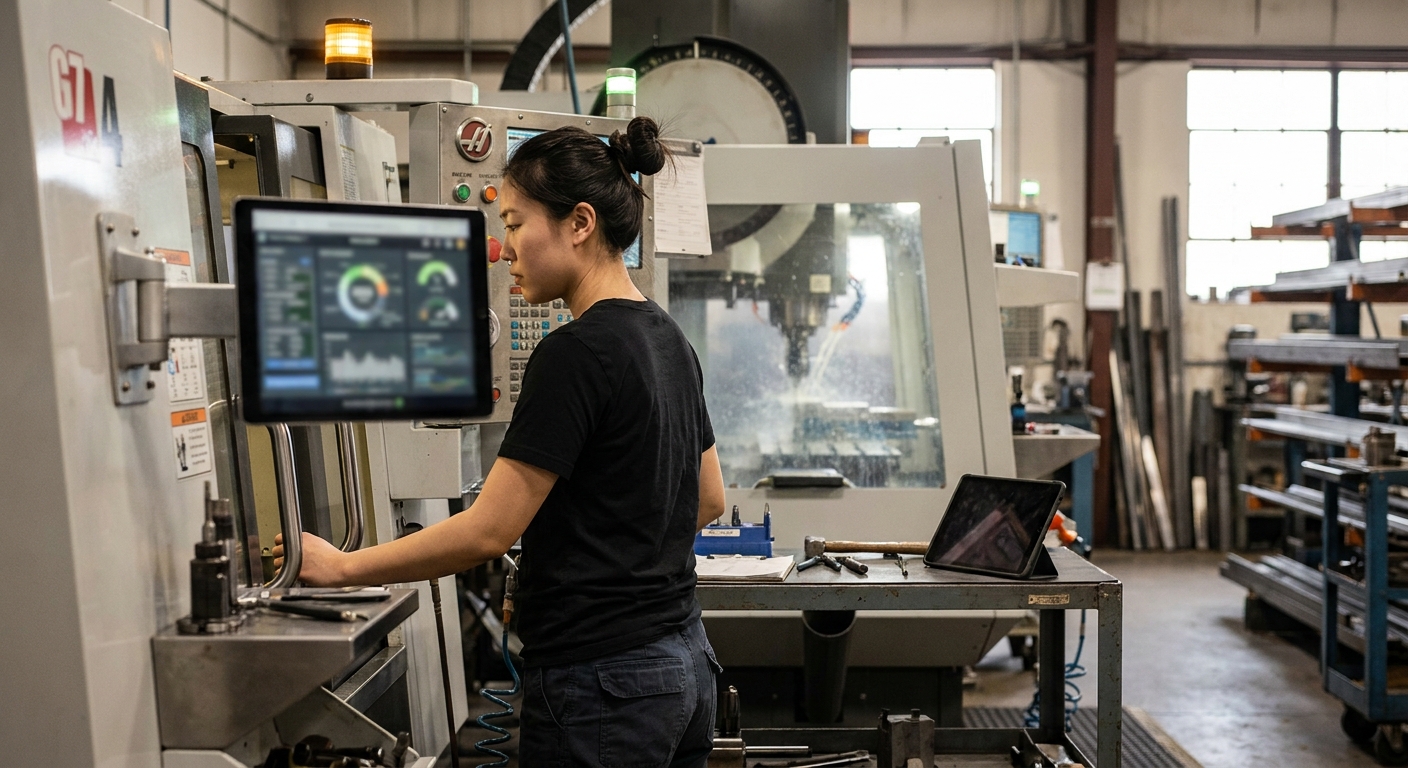
In a traditional lean shop, OEE gets calculated weekly. By the time the operations manager sees a downtime trend, the lost hours are gone. In a modern lean shop, OEE updates as machines run. Operators see their own numbers on a tablet at the workstation. Supervisors get alerted when cycle times drift past a threshold. The huddle still happens. It's just no longer the first time anyone sees the data.
A connected factory with real-time shop floor data doesn't replace daily standups. It makes them shorter and more useful. The team walks in knowing what happened. They spend the meeting deciding what to do.
2. Digital andon and e-kanban replace paper cards
Andon was always a real-time alert system. The problem with the pull-cord version was that it depended on someone physically being there to see the light or hear the buzzer. Digital andon routes the alert to phones, dashboards, and supervisor watches the moment a problem is flagged. The same thing happened to kanban. Paper cards get lost. Replenishment requests sit in inboxes. E-kanban triggers reorders the second consumption crosses the reorder point, and supplier portals get the signal without anyone retyping a form.
This is not a software upgrade for its own sake. It's the same lean tool with the manual handoff removed.
3. AI-augmented kaizen scales continuous improvement
This is the biggest shift since the publication of The Machine That Changed the World in 1990. Kaizen used to be limited by how many engineers you had walking the floor. AI vision systems and assembly copilots now catch deviations no human reviewer could.
A medical device manufacturer cut its scrap rate by 60% by deploying an AI assembly copilot across four workstations, per a 2025 case study from Retrocausal. A lighting control panel manufacturer raised first-pass yield from 64% to 83% using the same approach. BD (Becton Dickinson) launched its BD Excellence program in 2024 and scaled from 50 kaizen projects to 1,500 in a single year, partly because AI made it possible to identify improvement opportunities at a pace human teams could not match. BD's CEO Tom Polen told Fortune in February 2026 that lean is a prerequisite for using AI well, not a competing philosophy.
The work is still kaizen. The detection is just faster and broader than a human walk-through.
The modern lean tools that matter for small and mid-size shops
You don't need a Toyota-sized budget. The cost of the underlying technology has collapsed. A 40-person shop can deploy most of the following for less than the price of one CNC.
- MES or shop-floor visibility software. Tracks work orders, machine state, and labor in real time. Replaces the weekly OEE spreadsheet. This is the foundation; everything else plugs into it.
- Connected worker platform. Digital work instructions, guided procedure checklists, and remote help on a tablet at the workstation. The connected worker market grew to roughly $7.79 billion in 2024 and is forecast to reach the $40-billion range by 2034, per Polaris Market Research. Over 40% of manufacturers worldwide are using or planning to use connected worker tools within two years.
- IIoT sensors and machine integration via OPC UA or MQTT. Machine state without operator input. Predictive maintenance via IIoT sensors has been shown to cut downtime by up to 50% and maintenance costs by 40%, per Ease.io's 2024 industry analysis.
- AI-assisted vision and assembly guidance. Catches first-pass yield issues at the station, not at final inspection.
- Digital andon and e-kanban. Plug into the MES. Replace the cords and the cards.
None of this replaces 5S, value stream mapping, takt time, or standard work. It runs on top of them. A shop with no continuous improvement culture will not get value from any of these tools. A shop with strong lean discipline and live data will pull ahead of competitors stuck in the 2005 playbook.
What this looks like in a real shop
Consider a 65-person contract manufacturer in Michigan running 18 CNC machines and an assembly cell. In the 2005 playbook, the morning huddle reviews yesterday's downtime from a whiteboard, the kaizen rate is roughly two improvements a month, and OEE gets reported monthly to ownership.
After moving to modern lean: machines report state through OPC UA into a shop-floor system. Operators run digital work instructions on Fire tablets at each station. An e-kanban setup signals raw bar stock reorders to the supplier automatically when consumption hits a threshold. A vision system flags assembly variance at one of the manual stations.
In the first six months, the team reports OEE rising from 58% to 71% on the bottleneck cell. Scrap drops by half. The kaizen rate moves from two improvements a month to eleven, because operators now flag improvement candidates from the tablet instead of remembering them at the next huddle. The lean culture didn't change. The lag between problem and action did.
These numbers are realistic for shops that pair lean discipline with modern lean manufacturing tooling. They are not realistic for shops that buy software and skip the work.
What to keep from 2005
Plenty.
- The five principles. Customer value, value stream, flow, pull, perfection. They predate Toyota and they predate every piece of software on this list.
- Gemba walks. Walking the floor and watching real work is still the most valuable hour an operations leader spends in a week.
- 5S and visual management. A clean, organized workstation is the prerequisite for any digital tool that runs on it.
- Respect for people. Toyota's own framing puts this above any tool. The point of lean tools for manufacturers is to make work easier and more meaningful, not to surveil operators.
- Standard work. A tablet at the station without standard work behind it is just bad PDFs.
The Deloitte 2025 survey found that 35% of manufacturing executives named adapting workers to the factory of the future as a top concern. That concern is real. Modern lean fails the same way old lean failed: when it gets imposed on people instead of built with them.
How to make the move without breaking what already works
Start narrow. Pick the bottleneck cell. Instrument it. Run the connected worker setup with the operators who already lead kaizen. Measure for ninety days against the same OEE baseline you already track. If it works on one cell, the rest of the shop will ask for it.
Avoid the trap of treating it as a separate program from your existing one. It is not Industry 4.0 in opposition to lean. Hershey's manufacturing leadership has been public about this: their program sits inside the same continuous improvement structure that already existed. The technology is the new tool, not the new philosophy. Toyota's 2025 production system update merges Jidoka and just-in-time with real-time data dashboards and AI-driven process tools, what some analysts call "Lean 4.0." Toyota didn't replace TPS. They updated the tooling.
If your shop is still running continuous improvement in manufacturing on whiteboards and paper, you don't need to throw out what works. You need to give it a faster nervous system.
FAQs
Is lean in manufacturing still relevant in 2026?
Yes. Lean in manufacturing remains the dominant operations philosophy for discrete and process manufacturers worldwide. The National Association of Manufacturers reports nearly 70% of US manufacturers have adopted some form of automation, much of it deployed against lean manufacturing principles. What has changed is the toolset. The current generation keeps the five principles and adds real-time data, AI-assisted kaizen, and connected-worker tablets to act on waste in seconds instead of days.
What is digital lean?
Digital lean is the application of real-time data, IIoT, and AI to traditional lean practices. Instead of replacing 5S, kanban, value stream mapping, or standard work, the digital version accelerates each one. Deloitte has reported these projects can deliver up to 30% cost reductions, roughly double the 15% typically seen from traditional methods alone. The approach works only when the underlying culture is already in place.
Do small manufacturers need expensive Industry 4.0 systems to run modern lean?
No. The cost of the foundational tools has dropped substantially. A connected worker platform, a basic MES with OEE tracking, a few IIoT sensors, and an e-kanban tool can be deployed for a fraction of what a single CNC machine costs. The investment that matters most is still cultural: lean tools for manufacturers, digital or analog, only deliver returns when the shop already practices continuous improvement in manufacturing.
The takeaway
The 2005 lean playbook was right. It is still right. It is just slower than it has to be. The shops winning in 2026 are not the ones abandoning lean. They are the ones running the same playbook with a real-time data layer underneath it.
If you want to see what a modern lean shop floor actually looks like, take a look at how shop-floor visibility sits on top of the lean tools you already use.