The Toyota Production System for Job Shops
The 60-second answer
The Toyota Production System is a manufacturing method developed at Toyota Motor Corporation between roughly 1948 and 1975, primarily by engineer Taiichi Ohno. It produces high-quality parts in small batches by attacking two things: waste and variability. The toyota production system definition that Ohno gave in his 1978 book is the canonical one: a system built on two pillars, just-in-time production and jidoka (automation with a human touch), aimed at making only what the next process needs, when it needs it, in the quantity it needs.
For a 30-person machine shop in Ohio, that is not the same thing as "copy Toyota." It is closer to: stop running parts you do not have orders for, stop hiding defects, and give the operator the authority to stop the line when something is wrong.
Why generic lean advice fails for small manufacturers
Most lean consulting was built for plants making the same part 10,000 times. Job shops make 30 of one part, then never make it again. That breaks half the toolkit.
Heijunka (production leveling) assumes you have a stable product mix to level. A contract machine shop quoting 80 RFQs a month does not. Single-piece flow assumes a routing that repeats. A fab shop running one-off weldments does not have one. Kanban assumes consumption is predictable enough to set a card quantity. For a shop where 60% of next month's work has not been quoted yet, it is not.
What does carry over, almost without translation:
- The two pillars: just-in-time and jidoka
- The 7 wastes (more on this below)
- Andon and the right to stop the line
- Standard work for setups
- Visual management of WIP
- The 5 Whys
The rest needs adaptation. Some of it needs to be thrown out. The shops doing this well are not running Toyota's playbook. They are running their own playbook, informed by Ohno's principles.
The system Ohno actually built
Taiichi Ohno credits two influences in his book: Henry Ford's flow-production ideas from the Highland Park plant, and the American supermarket, which restocked shelves based on what customers took, not on a forecast. Ohno saw the supermarket in 1956 and built kanban around it.
The system has two pillars.
Pillar 1: Just-in-time (JIT)
Make only what is needed, when it is needed, in the amount needed. The downstream process pulls from the upstream process. The upstream process makes nothing until pulled. This is the opposite of MRP-style push scheduling, where you make to a forecast and hope it matches reality.
In a Toyota plant, this looks like kanban cards moving between stations. In a job shop, the pull signal is the customer order itself. You make the part when the order lands, not when a forecast says you might sell one.
Pillar 2: Jidoka
Often translated as "autonomation" or "automation with a human touch." A machine or operator stops the process the instant a defect is detected. In Toyota's Tsutsumi plant, every operator has an andon cord. Pulling it halts the line.
The point is not to halt production. It is to make problems impossible to hide. If a defect cannot pass to the next station, the only options are fix the process or stop. There is no third option called "ship it and warranty it later."
For a job shop, jidoka means an operator who finds a bad part scraps it on the spot, flags the cause, and does not run another until the cause is understood. Most shops do the opposite: keep running, sort it out at final inspection, eat the scrap silently.
The 7 wastes (and how to find them in your shop)
Ohno identified seven categories of waste, called muda. They are the most portable part of the system. Every one of them shows up in a job shop.
- Overproduction. Making 12 when the order is for 10 "in case." The extras occupy bin space, get damaged, get scrapped at year-end. Worst form of waste because it hides the others.
- Waiting. Parts sitting between operations. A part touched for 6 minutes of cycle time but in the shop for 9 days is 99.9% waiting.
- Transport. Moving material between buildings, between floors, across the shop because the layout grew without a plan.
- Over-processing. Tighter tolerance than the print calls for. Polishing surfaces the customer cannot see. Inspecting features the customer does not measure.
- Inventory. Raw stock you bought because it was on sale. Finished goods waiting on a held-up release. Tooling for a job that ran in 2019.
- Motion. The setup person walking 40 feet to the tool crib three times per changeover.
- Defects. Scrap, rework, customer returns, the cost of inspection that exists only because defects exist.
Some practitioners add an eighth: unused human talent. The operator who knows the fixture is wrong but is not asked.
How a small US shop applies the tps production system
You do not need a kanban board or a Toyota Way poster. You need three things: visibility, the right to stop, and a habit of asking why.
Make work-in-progress visible
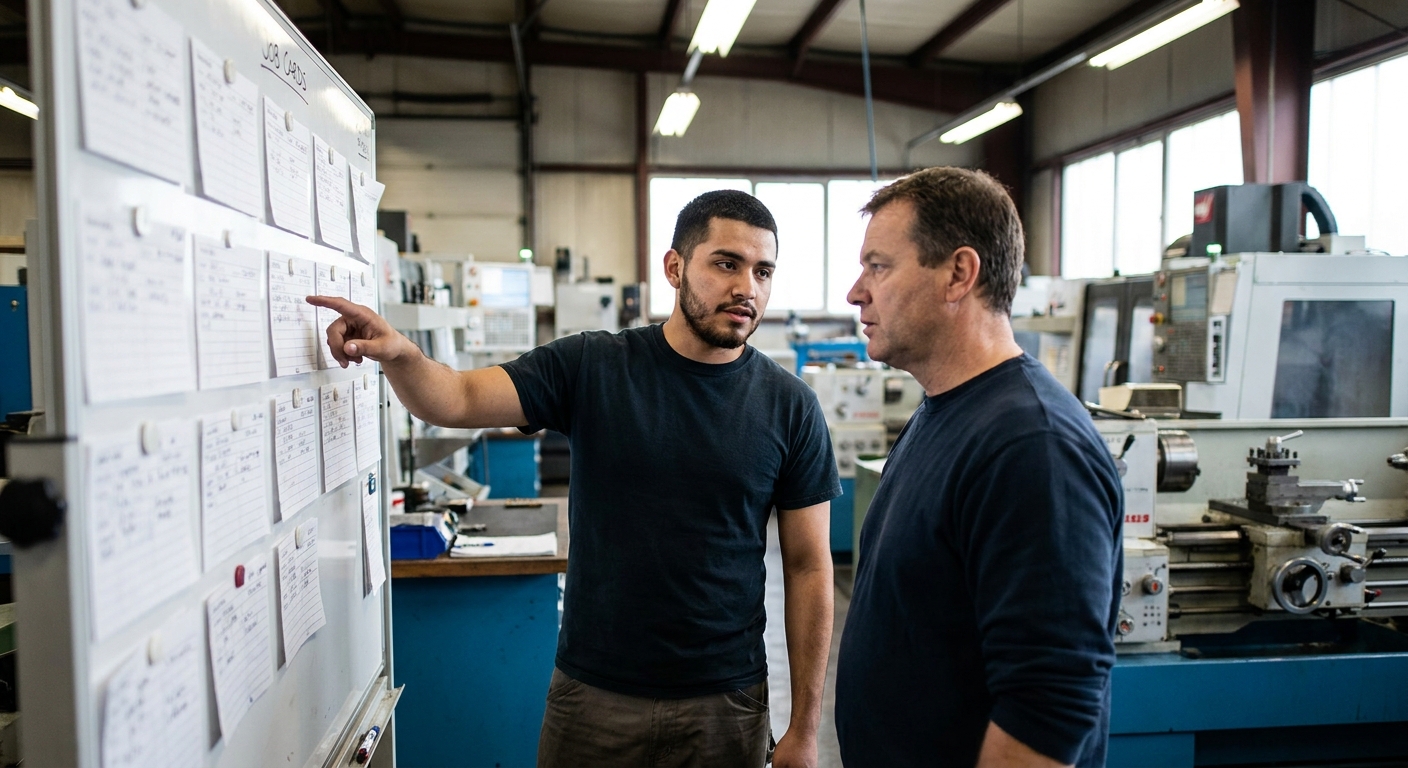
You cannot reduce WIP you cannot see. The first move in most shop transformations is the same: put every open job on a board. Not in a spreadsheet. Not in three spreadsheets. On a board the whole shop walks past.
Modern manufacturing software handles the digital version of this. A live shop floor view that shows every job, every operation, and every queue makes the same hidden WIP visible without printed cards. The principle is Ohno's; the medium is current.
Schedule the bottleneck, not the shop
Toyota balanced its lines so no one station was the bottleneck. Job shops cannot balance, because the mix changes weekly. So the right adaptation is Eli Goldratt's: identify the bottleneck, schedule that one resource tightly, and let everything else float. This is closer to drum-buffer-rope than to classical TPS, and that is fine. Pure dogma is not the goal. Finite capacity scheduling on the constraint is what matters.
Give operators a real andon
Most shops have a verbal andon: the operator tells the lead. By the time the lead tells the supervisor, the part is already at the next station. A real andon is a button, a light, or a digital flag that stops dispatch on that job and pings the right person. The cost of stopping for 8 minutes to fix the cause is almost always lower than the cost of running 200 more bad parts.
Run 5 Whys on every nonconformance
Five Whys is not a meeting. It is two minutes at the machine. A part is out of tolerance. Why? The boring bar deflected. Why? The stickout is 4.5 inches. Why? The fixture forces it. Why? The fixture was designed for a different part. Why? Nobody updated the setup sheet when the customer revised the print. Now you have an actual fix: rev-control the setup sheet to the part number.
Three of the five whys above are process problems, not operator problems. That is the usual ratio.
Example: what this looks like at a 40-person machine shop
A composite picture, drawn from how small US shops typically apply these ideas.
A 40-person contract shop in Michigan was running 35-day average lead time on parts with 4 hours of actual machining. WIP was sitting in tubs between operations. Final inspection found 8% scrap; nobody knew where it came from.
They did four things over six months:
- Put every open job on a physical board, with operation-level status. Lead time on the board became a number people argued about, which is the point.
- Identified the bottleneck (one 5-axis machine), scheduled that one resource at 85% loaded, let everything else queue ahead of it.
- Added a hard rule: any operator who finds a bad part halts the job, scraps the part, and writes the cause on a card before running the next. No exceptions.
- Ran 5 Whys on every scrap card for one quarter.
Lead time dropped from 35 days to 12. Scrap dropped from 8% to 2.3%. They did not adopt kanban. They did not level production. They took the parts of TPS that fit a job shop and left the rest.
Where modern software changes the math
Ohno's system used paper cards because paper was what he had. The principle was not "paper cards"; the principle was "downstream tells upstream what to make, in the quantity needed, at the time needed." That signal can be a paper card, a Kanban tile on a wall, or a job released in software when the customer order lands.
Three places software changes the equation for small shops:
- Real-time WIP visibility. A live view of every operation beats a board if (and only if) operators actually report status. If they do not, the board wins.
- Bottleneck-aware scheduling. Real-time scheduling that reschedules when a machine goes down is closer to Toyota's actual practice than a printed weekly schedule.
- Andon as data. A digital stop creates a record. A verbal stop does not. Over a year, the record is what tells you which machine, which part, which shift has the recurring issue.
The trap is buying software and skipping the cultural pieces. Software that nobody updates is a worse spreadsheet. The Toyota principle that travels best is the one Ohno repeated most: ask why, five times, every time.
Frequently asked questions
How would you explain the Toyota Production System in plain English?
It is a way of making things developed at Toyota that produces only what the next step needs, in the quantity needed, at the time needed, while making defects impossible to hide. The toyota production system tps rests on two pillars: just-in-time production and jidoka (stopping the process when something goes wrong). It was created mostly by Taiichi Ohno between 1948 and 1975 and described in his 1978 book.
What is the difference between TPS and lean manufacturing?
Lean manufacturing is the Western adaptation of the production system of toyota, popularized by the 1990 MIT book The Machine That Changed the World by Womack, Jones, and Roos. TPS is the original Japanese system; lean is the broader, exported version. The core ideas (eliminate waste, pull-based flow, respect for people, continuous improvement) carry across. Some specifics, like heijunka leveling, work better in repetitive production than in job-shop work.
Can a small job shop actually use the Toyota Production System?
Yes, but selectively. The two pillars and the 7 wastes apply directly. Kanban and heijunka often do not, because job-shop mix is unstable. The right pattern is: adopt the principles, adapt the tools. The shops that succeed do not try to be Toyota; they take Ohno's diagnostic lens and apply it to their own constraints.
Where to go from here
Most shops do not need a lean consultant. They need a board, a stop-the-line rule, a habit of asking why, and software that does not get in the way.
WorkCell is a manufacturing operating system built for small and mid-sized US shops. It is not a Toyota replica. It is the tooling that makes Ohno-style discipline possible without a 24-month rollout.
Book a demo and we will show you what it looks like with your parts and your routings.