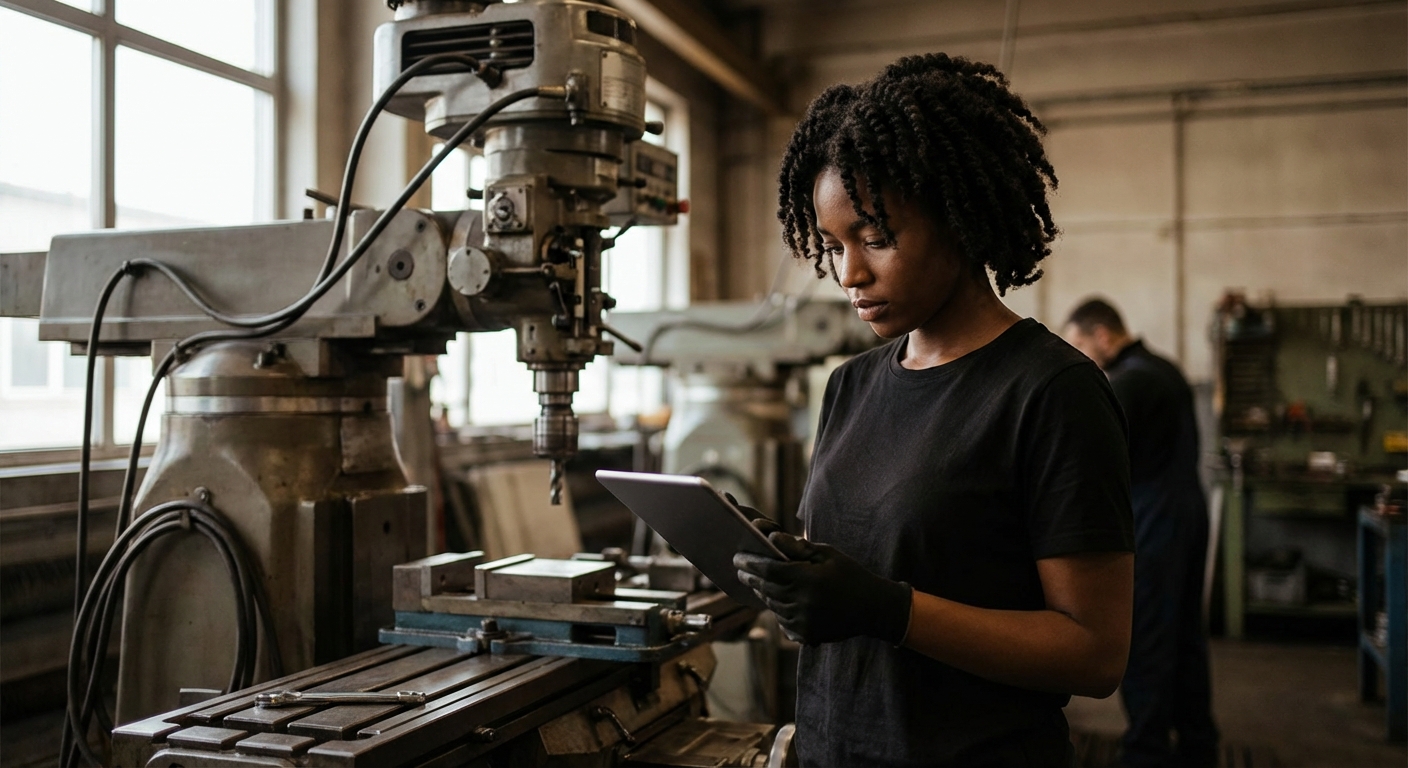
Practical Ways AI Helps on the Shop Floor
Introduction
Every manufacturing conference in 2025 had "AI" in every other session title. Every software vendor suddenly had AI features. Every consultant promised AI would transform your operation. The hype was deafening.
Meanwhile, on actual shop floors, adoption tells a different story. Recent studies show that only about 9% of production and frontline workers frequently use AI tools. That number has been flat for two years. The gap between boardroom excitement and shop floor reality is enormous.
This article cuts through the noise. We'll cover five specific ways AI actually helps on the shop floor, with concrete examples rather than vague promises. We'll also be honest about what AI won't do, because understanding limitations is just as important as understanding capabilities.
The problem with most AI conversations
Manufacturing leaders are justifiably skeptical about AI. They've heard similar promises before. Cloud computing was going to solve everything. IoT was going to revolutionize operations. Mobile apps would transform productivity. Some of those technologies delivered, some didn't, and all of them took longer and cost more than the pitch decks suggested.
AI faces the same credibility problem, amplified. Vendors throw around buzzwords without explaining what their AI actually does. "Machine learning capabilities" could mean anything from sophisticated prediction algorithms to a basic rules engine with better marketing. When asked for specifics, demonstrations often show idealized scenarios that don't resemble real manufacturing environments.
The skepticism makes sense. Before investing in AI tools, manufacturers want to know exactly how they work and whether the benefits justify the complexity. Fair enough. Let's get specific.
1. Smarter production scheduling
Traditional scheduling approaches create a plan and then struggle when reality diverges from the plan. A machine goes down. A rush order arrives. A material shipment is late. Each disruption requires manual intervention, often cascading into delays across multiple jobs.
AI scheduling works differently. Instead of creating a static plan, AI continuously monitors what's happening on the floor and adjusts the schedule in real-time. When that CNC machine goes down at 10 AM, the system immediately evaluates which jobs can move to alternative machines, which should wait, and which affect customer delivery commitments. You see the revised schedule within seconds, not hours.
The value isn't that AI replaces scheduling decisions. It's that AI handles the constant recalculation that humans can't keep up with. Every job completion, every delay, every new order triggers a reassessment of the optimal path forward.
This matters most in high-mix environments where the schedule changes constantly. If you run the same products on the same sequence week after week, you might not need continuous optimization. But if rush orders are common and capacity is tight, AI scheduling can be the difference between controlled chaos and actual chaos.
For a deeper comparison of approaches, see our article on real-time vs. static scheduling.
2. Quote accuracy that learns
Quoting custom work is notoriously difficult. Standard rate tables don't account for the specific complexities of each job. Estimators rely on experience and intuition, which works until they leave or until job complexity exceeds their mental model.
AI quoting takes a different approach. The system analyzes your actual job history: not just what you estimated, but what jobs actually cost. It finds patterns that humans miss. Maybe jobs using a particular material consistently run 12% over estimate. Maybe a certain customer's specs always require extra deburring time that doesn't show up on the print. Maybe setups on one machine take longer when preceded by a specific type of job.
These patterns exist in your data. No human has time to find them all. AI can.
The system builds a model specific to your shop, based on your actual costs with your equipment and your workforce. As you complete more jobs, the model gets smarter. Quote accuracy improves over time rather than staying static.
This matters for margin. Job shops that consistently underquote bleed money. Shops that overquote lose bids to competitors. AI that narrows the gap between estimate and actual cost is worth real money.
3. Quality pattern detection
Quality problems rarely appear suddenly. Usually there's a pattern: gradual drift, correlation with specific conditions, or subtle interactions between variables. The challenge is that human inspectors can't track enough variables across enough jobs to spot these patterns before they become costly.
Consider a real scenario. A shop starts seeing higher scrap rates on aluminum parts. Quality checks pass most pieces, but more are failing than usual. Traditional root cause analysis looks at the immediate factors: operator, machine, tooling. But the AI system, which connects purchasing data to production data to quality data, notices something else. The higher scrap rate correlates with a specific material lot from a supplier whose quality has been declining over the past quarter.
That connection, between a purchasing decision and a quality outcome weeks later, is nearly impossible for humans to make without AI.
AI quality systems monitor in real-time, flagging deviations as they happen rather than after the job ships. They learn what "normal" looks like for each operation and alert when parameters drift outside expected ranges. The goal isn't to replace inspectors, but to give them earlier and better information.
For more on tracking equipment performance, see our guide to OEE explained.
4. Predictive maintenance
Unplanned downtime is one of manufacturing's most expensive problems. When a machine goes down unexpectedly, the costs cascade: lost production, rush repairs, missed delivery dates, overtime to catch up.
Traditional maintenance approaches are either reactive (fix it when it breaks) or schedule-based (service at fixed intervals regardless of actual condition). Neither is optimal. Reactive maintenance means expensive surprises. Scheduled maintenance means servicing equipment that doesn't need it while missing problems on equipment that does.
AI predictive maintenance uses sensor data and historical patterns to predict when maintenance will actually be needed. Temperature readings, vibration data, power consumption, cycle times. The AI learns what patterns precede failures and alerts before the failure occurs.
McKinsey research suggests this approach can reduce unplanned downtime by up to 50% and extend machine life by up to 40%. Those numbers matter for any shop where equipment availability drives throughput.
The prerequisite is data. You need sensors on your equipment and a way to collect that data continuously. For shops already investing in connected machines and IoT, predictive maintenance becomes a natural next step.
5. Natural language queries
Most manufacturing software requires users to navigate complex interfaces, remember which screen has which report, and understand query syntax or filter options. This creates barriers, especially for operators who use the system occasionally rather than constantly.
Natural language AI changes this. Instead of navigating menus, you ask questions in plain English. "What jobs are running late this week?" "Which work centers have the most overtime scheduled?" "What's our scrap rate on aluminum parts compared to last quarter?"
The AI interprets your question, pulls the relevant data, and presents an answer. No training required on report builders or query syntax. If you can describe what you want to know, you can get the answer.
This matters for adoption. Shop floor workers often won't use software that requires multiple clicks and navigation. But if they can type a question and get an answer, they're more likely to actually use the tools available to them. The gap between "technically possible" and "practically useful" often comes down to interface friction.
AI-native manufacturing software builds this kind of interaction throughout the system, not just in a separate "AI chat" module.
What AI won't do (the honest part)
Plenty of vendors will promise AI solves everything. They're wrong. Understanding limitations is crucial before investing.
AI won't fix bad data. Machine learning systems learn from your historical data. If that data is wrong, incomplete, or inconsistent, AI learns the wrong things. Garbage in, garbage out, but faster and at scale. Before adopting AI tools, honest assessment of data quality is essential. If work orders are incomplete, time tracking is inconsistent, or inventory counts are wrong, AI will amplify those problems rather than fix them.
AI won't replace operator expertise. The best AI systems augment human judgment rather than replacing it. A skilled machinist knows things that aren't in the data: how a particular material is behaving, what a slight change in sound means, when to trust the process versus when to intervene. AI helps operators make better decisions. It doesn't make operators unnecessary. That said, AI can help capture and preserve what experienced operators know so that expertise isn't lost when they retire.
AI won't solve organizational problems. If your shop has communication issues between departments, or if scheduling conflicts with sales, or if quality and production are at odds, AI won't fix those dynamics. Technology can't paper over dysfunction. Sometimes the obstacle is process or culture, not software.
AI requires investment beyond the software. Training, change management, data cleanup, integration work. The license fee is often the smallest cost. Shops that underestimate the organizational investment often fail to see the benefits that justified the purchase.
Getting started without boiling the ocean
Manufacturers who succeed with AI typically start small. Pick one problem that matters, solve it, demonstrate value, then expand.
Good starting points include:
Scheduling if your current approach is a bottleneck. If your scheduler is overwhelmed by constant changes and rush orders, AI scheduling delivers visible relief quickly.
Quoting if margin variance is a problem. If you're frequently surprised by job costs coming in over or under estimate, AI that learns from your actual costs pays for itself.
Maintenance if unplanned downtime is expensive. If one unexpected failure can wipe out a week's profit, predictive maintenance justifies the investment fast.
The wrong approach is trying to implement everything at once. Pick a use case, prove it works, build organizational confidence, then expand.
Conclusion
AI on the shop floor isn't magic. It's a set of capabilities (analysis of large datasets, pattern recognition, continuous optimization) that humans can't match at scale. Applied to the right problems, AI delivers real value: better scheduling, more accurate quotes, earlier quality detection, reduced downtime, easier access to information.
Applied to the wrong problems, or without attention to data quality and organizational readiness, AI delivers disappointment and wasted investment.
The manufacturers who benefit most are those who approach AI with clear eyes. They understand what it can and can't do. They start with specific problems rather than vague transformation projects. They invest in data quality and change management alongside the technology. They measure results and iterate based on what works.
The hype will fade. The practical applications will remain. For shops willing to do the work, AI is a genuine competitive advantage.
Ready to see AI in action on real manufacturing data? Book a demo and we'll show you how WorkCell approaches these problems.