Introduction
Your CNC has been idle for 38 minutes. Nobody knows.
The operator stepped away to help with a setup problem. The supervisor is in a meeting. The whiteboard still says "running." Your daily production target just got 38 minutes further from reality.
This is what flying blind looks like. And it happens every day in shops that rely on manual tracking, end-of-shift reports, and supervisors who "know what's going on."
IoT changes this. The Internet of Things, or IoT, means connecting your physical equipment to your digital systems. Machines report their own status. No human entry required. No waiting for someone to update a spreadsheet.
Here's what that actually means for your shop floor operations.
What IoT actually does on the shop floor
Strip away the buzzwords and IoT is simple: it connects machines to software.
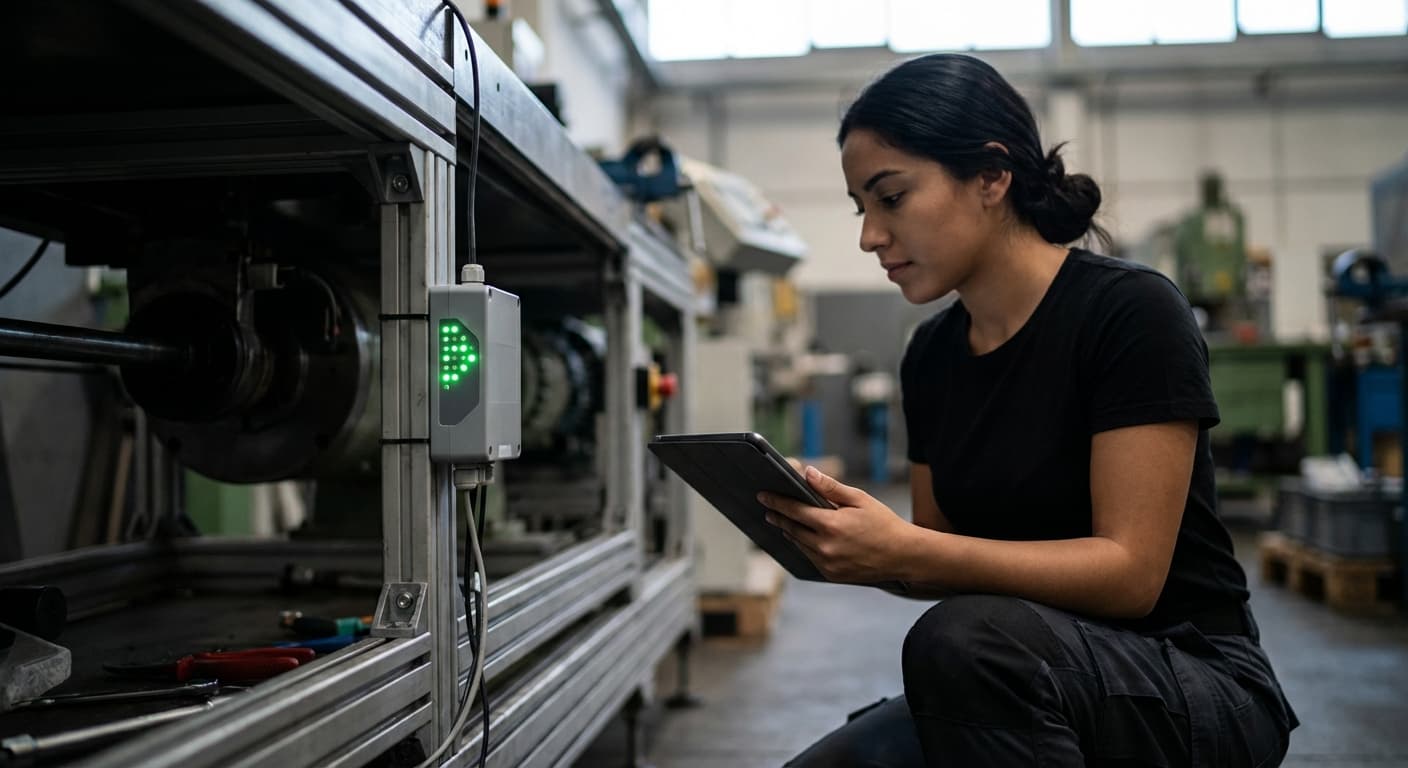
A sensor on your CNC detects when the spindle is running. That data flows through your network to your manufacturing software. The software updates a dashboard. You see "Machine 3: Idle since 2:47 PM" without walking to the floor or asking anyone.
That's it. Sensors collect data. Networks transmit it. Software displays it. The magic isn't in any single piece. It's in the connection.
Here's what makes IoT data different from what you have now:
- Data flows continuously, not in batches
- Machines report every cycle, every stop, every status change
- You see what's happening now, not what happened yesterday
This isn't science fiction. Manufacturers have connected equipment for decades. What's changed is the cost and accessibility. You don't need a six-figure integration project anymore. Modern manufacturing software comes IoT-ready.
The difference between IoT data and manual data
Manual data depends on people. People forget. People get busy. People round numbers. People log at the end of their shift what they vaguely remember from the morning.
IoT data doesn't forget. The machine reports every cycle. Every stop. Every start. With timestamps accurate to the second.
The result? IoT data is consistent, continuous, and unbiased. Manual data is sporadic, delayed, and filtered through human memory.
This matters more than you might think. When you're trying to figure out why Tuesday's output was 15% lower than Monday's, "the operator thinks the machine was down for about an hour" doesn't help. Knowing the exact downtime, when it started, and what code the machine reported does.
How IoT changes daily operations
Let's get specific. Here's what actually changes when your shop floor is connected.
Machines report their own status
Today, knowing if a machine is running requires one of three things:
- Walking to the floor and looking at it
- Calling the operator and interrupting their work
- Waiting for the end-of-shift report
With IoT, you open a dashboard. Green means running. Red means stopped. Yellow means something needs attention. No walking. No calls. No waiting.
Downtime gets logged automatically with timestamps. When Machine 4 stops at 10:23 AM and starts again at 10:47 AM, the system records 24 minutes of downtime. The operator didn't have to remember to log it. The supervisor didn't have to chase it down. It just happened.
You know immediately when something stops. Not when someone decides to tell you. Not at the 3 PM standup meeting. Now.
Data becomes continuous, not snapshot
The traditional approach gives you snapshots. End-of-shift reports. Daily summaries. Weekly reviews. You're always looking at history, making decisions based on what already happened.
IoT data is continuous. Every second, you have current information. The dashboard shows what's happening right now, not what happened six hours ago.
This shifts decision-making from reactive to proactive. You see a machine trending toward a problem before it becomes one. You notice a job falling behind while there's still time to adjust. You catch issues when they're small, not when they've become expensive.
Real-time visibility isn't just convenient. It's the difference between managing your floor and chasing it.
Operators focus on operating, not logging
Every minute an operator spends entering data is a minute they're not making parts. Manual tracking systems create a constant tension: the shop needs accurate data, but logging that data slows production.
IoT resolves this. The machine captures its own data. The operator focuses on running parts, not feeding a system.
Less manual entry also means less interruption. No supervisor walking up to ask "how many did you run?" The system already knows.
What you can actually track with IoT
Abstract capabilities don't help you. Here's what you can actually see with connected machines:
Cycle counts. How many parts came off the machine this hour? Today? This week? No counting, no tally sheets, no "let me check."
Run/stop status. Is the machine running, idle, or down right now? Not "probably running because the operator is there." Actually running, confirmed by spindle load or cycle signal.
Downtime with reasons. When a machine stops, why? Some systems capture fault codes directly. Others let operators select a reason from a short list. Either way, you know the cause, not just the fact.
Utilization rates. Actual running time versus available time, calculated automatically. No spreadsheet formulas. No manual time tracking. The machine tells you how much it actually ran.
OEE components. Overall Equipment Effectiveness combines availability, performance, and quality into a single number. With IoT, you calculate it live instead of estimating it monthly.
The data is only valuable if you use it. A dashboard with 50 metrics you never check is worse than no dashboard at all. Start with the questions that matter most: Is this machine running? How much did we produce? Where did we lose time?
What IoT doesn't do
Let's be honest about limitations. IoT isn't a silver bullet.
IoT doesn't fix bad processes. If your scheduling is chaotic, adding sensors just shows you the chaos faster. You still need to fix the underlying problems. IoT exposes issues. It doesn't solve them automatically.
IoT doesn't replace operators. Connected machines still need people to run them. The difference is that those people have better information. They spend less time on manual tracking and more time on actual production.
IoT doesn't work without software. Sensors alone are just expensive blinking lights. You need software designed to receive, store, and display the data. If your current system wasn't built for real-time machine data, you'll need middleware, custom development, or a new system entirely.
Implementation requires planning. Which machines to connect? What data to capture? How to handle edge cases? Rushing to "instrument everything" leads to expensive projects that deliver confusing dashboards nobody uses.
Start with clear goals. What decisions are you trying to make? What information do you need to make them? Work backward from there.
Getting started with IoT on your shop floor
You don't need to connect every machine on day one. In fact, you shouldn't. Here's a practical path.
Start with one machine
Pick a bottleneck. Or a machine that runs high-value jobs. Or the one that causes the most headaches when it goes down unexpectedly.
Connect that one machine. Prove the value. Learn what works and what doesn't in your environment. Then expand.
This approach costs less, teaches more, and delivers results faster than a plant-wide rollout. Avoid the "instrument everything" trap. Focus on what matters first.
Define what you want to know
Don't collect data for data's sake. Before you connect anything, answer these questions:
- What decisions am I trying to make?
- What information do I need to make them?
- How will I act differently with this data?
If you can't answer these, you're not ready for IoT. You're ready for more planning.
Good starting questions: Is this machine running? How long was it down? Why did it stop? Those three questions drive real value. Start there.
Choose software that's IoT-ready
This is where most implementations stumble. The machines can connect. The sensors can collect. But the software can't use the data.
Some manufacturing systems were designed for machine connectivity from the beginning. They have built-in device management, real-time dashboards, and architectures that handle streaming data. If you're choosing manufacturing software, IoT readiness should be on your checklist.
Other systems require expensive middleware, custom integrations, or third-party platforms just to receive machine signals. By the time you've duct-taped everything together, you've spent more than a purpose-built solution would have cost.
Look for:
- Native device management, not third-party add-ons
- Real-time data architecture, not batch uploads
- Simple connection methods for common equipment
- Dashboards that show live machine status out of the box
Conclusion
IoT changes shop floor operations by making machines talk to your software. Your CNC doesn't wait for an operator to log downtime. It reports the stop immediately. Your dashboard doesn't show yesterday's numbers. It shows right now.
This isn't about fancy technology for its own sake. It's about knowing what's happening without asking, catching problems when they're 5 minutes old instead of 5 hours old, and freeing operators to focus on making parts instead of entering data.
The manufacturers who know what's happening outperform the ones who are guessing. That's always been true. IoT just makes knowing possible in ways that weren't before.
Start small. Connect one machine. Answer one question. Prove the value. Then expand.
Ready to see a shop floor that's actually connected?
WorkCell is built IoT-ready from day one. Connect your machines, see real-time status, and get actual data instead of guesses. No middleware. No six-month integration projects.
Book a demo and we'll show you what it looks like with your actual data.
We build manufacturing software and spend our time in the shops that run it. What we write comes from watching jobs move across real floors and from building the system that has to keep up with them.